
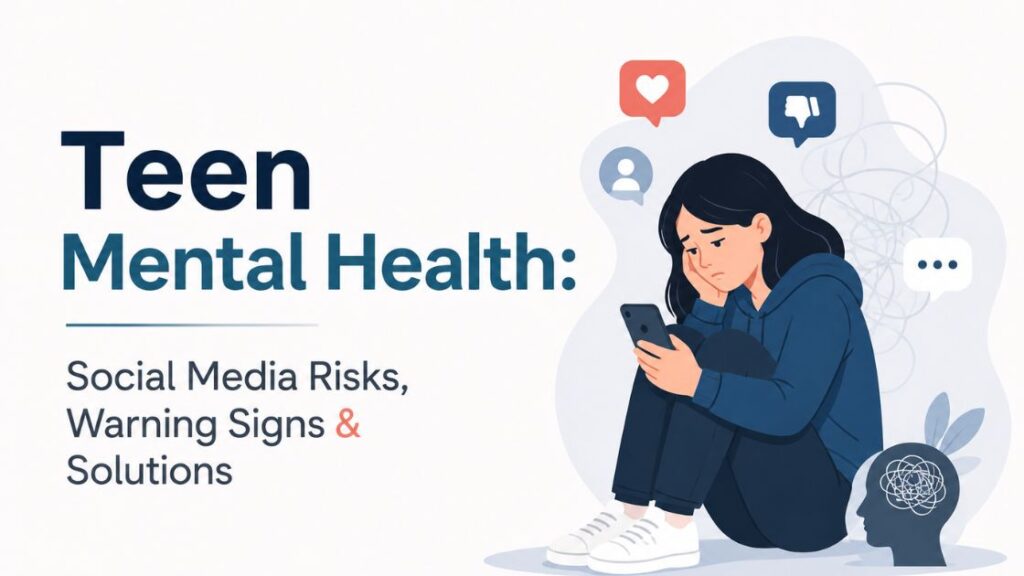
Social media is now a normal part of teenage life. Instagram, YouTube, Snapchat, WhatsApp, TikTok, and other platforms help teenagers stay connected, discover new interests, express themselves, and find communities. But when scrolling becomes constant, comparison becomes stressful, or online experiences start affecting sleep and relationships, Teen Mental Health can suffer.
The important point is that social media is not automatically harmful. Its impact depends on what teenagers see, how they use it, how much time they spend online, and what is happening in their offline life.
Current research supports a balanced approach rather than simply blaming social media. The U.S. Surgeon General notes that social media can offer benefits while also presenting meaningful risks, and says current evidence is not enough to conclude that social media is sufficiently safe for children and adolescents.
Why Teen Mental Health Needs Special Attention
Adolescence is a period of major emotional, social, and brain development. Teenagers are learning how to manage emotions, form relationships, make decisions, and develop their identity.
According to the World Health Organisation, one in seven young people aged 10–19 experiences a mental health condition, with anxiety and depression among the leading causes of illness and disability in this age group.
This makes Teen Mental Health an important issue for parents, schools, and communities.
Social media does not operate in isolation. Academic pressure, family conflict, bullying, loneliness, body-image concerns, financial stress, and existing anxiety or depression can all influence how a teenager responds to online experiences.
What Does Research Say About Social Media and Teenagers?
The research is important, but it needs to be understood carefully.
A systematic review of 32 studies examining social media use and anxiety among adolescents found that more than half reported a positive association between social media use and anxiety. However, the researchers also noted differences in study quality and methods, meaning the relationship is not as simple as “social media causes anxiety.”
Another meta-analysis involving 18 studies and 9,269 adolescents and young adults found statistically significant associations between problematic social media use and symptoms of depression, anxiety, and stress.
A 2024 systematic scoping review of TikTok and adolescent mental health included 20 studies involving 17,336 participants across 10 countries. Researchers highlighted growing concern but also pointed out that the evidence remains diverse and more high-quality research is needed.
So the practical message is clear: problematic use deserves attention, but simply having a social media account does not mean a teenager will develop a mental health problem.
How Social Media Can Affect Teen Mental Health
1. Constant Social Comparison
Teenagers naturally compare themselves with others.
On social media, however, they may compare their appearance, friendships, lifestyle, clothes, marks, holidays, or achievements with carefully selected versions of other people’s lives.
A teenager may think:
“Everyone looks happier than me.”
“Why don’t I look like that?”
“Everyone has more friends than I do.”
Repeated comparison can affect self-esteem and body image.
The U.S. Surgeon General’s advisory reports that 46% of adolescents aged 13–17 said social media makes them feel worse about their body image.
2. Cyberbullying and Online Pressure
Bullying does not always stop at the school gate.
Comments, private messages, group chats, edited photographs, rumours, and embarrassing posts can follow teenagers home through their phones.
Because online content can spread quickly and remain visible, cyberbullying may feel impossible to escape.
Parents should take sudden changes in behaviour seriously, particularly if a teenager becomes unusually withdrawn, anxious, angry, or afraid of checking their phone.
3. Sleep Problems
Late-night scrolling is another major concern.
A teenager may go to bed at 10 p.m. but continue watching videos or chatting until midnight or later.
The problem is not only screen exposure. Notifications, emotionally stimulating content, and the habit of checking the phone can keep the brain engaged.
Poor sleep can then affect concentration, mood, school performance, and emotional regulation.
This creates a cycle:
Late-night scrolling → Poor sleep → Irritability and fatigue → More emotional stress → More screen use.
Protecting sleep should therefore be a major part of Teen Mental Health care.
4. Social Media Can Increase Social Isolation
It may sound strange, but being online all day does not always mean feeling connected.
A teenager may have hundreds of followers but still feel that nobody understands them.
Passive scrolling—watching other people’s lives without meaningful interaction—can be very different from having a genuine conversation with a friend.
The WHO’s recent research found that 11% of adolescents surveyed across 44 countries and regions showed signs of problematic social media behaviour, up from 7% in 2018. Girls reported problematic use more often than boys in that dataset.
Signs Social Media May Be Affecting Your Teenager
Parents should look at changes in behaviour rather than focusing only on the number of hours spent online.
Possible warning signs include:
- Sudden withdrawal from family
- Persistent irritability
- Declining school performance
- Losing interest in offline hobbies
- Sleeping very late
- Checking the phone constantly
- Becoming extremely upset about likes or comments
- Comparing appearance with influencers
- Avoiding friends or social activities
- Feeling anxious after using social media
One sign alone does not prove there is a mental health condition. But several changes happening together deserve a calm conversation.
What Parents Can Actually Do
Don’t Start With “Give Me Your Phone”
A strict ban may sometimes increase secrecy rather than solve the underlying problem.
Instead, ask:
“What do you enjoy about social media?”
“Does anything online ever make you feel bad?”
“Have you seen anything recently that upset you?”
A teenager who feels judged may stop sharing.
A teenager who feels heard is more likely to ask for help.
Create Family Digital Rules
Set clear rules that apply consistently.
For example:
- Phones stay away during meals.
- No social media during study time.
- Devices charge outside the bedroom at night.
- Notifications are reduced during sleep hours.
- Family members take regular offline breaks.
The goal is not to eliminate technology. It is to create healthy digital boundaries.
Protect Sleep
A practical rule is to create a screen-free period before bedtime.
Keep phones away from the bed if possible.
Encourage reading, music, light stretching, or a calm conversation instead of endless scrolling.
Good sleep is one of the simplest ways to support Teen Mental Health.
Encourage Real-World Activities
Online relationships should not replace offline life.
Encourage teenagers to participate in:
- Sports
- Music
- Art
- Reading
- Volunteering
- Outdoor activities
- Family time
- School clubs
These activities provide identity, confidence, and real social connection.
Teach Digital Literacy, Not Just Screen Limits
Teenagers need to understand how social media works.
Teach them that influencers may use filters, editing, lighting, advertising, and carefully selected content.
Help them ask:
Who created this content?
Why was it created?
Is it realistic?
How does it make me feel?
This helps teenagers become more thoughtful users rather than passive consumers.
When Should You Seek Professional Help?
If social media use is accompanied by persistent sadness, anxiety, severe sleep problems, self-harm, eating concerns, extreme withdrawal, or major changes in school and family life, professional evaluation is important.
Do not assume everything is caused by social media.
A mental health professional can look at the bigger picture and assess whether the teenager may be experiencing anxiety, depression, body-image concerns, ADHD, behavioural difficulties, or another condition.
Early support can prevent problems from becoming more difficult to manage.
A Healthier Approach to Teen Mental Health
The goal should not be:
“No social media.”
The goal should be:
“Healthy social media use.”
A healthier approach combines:
Good sleep + Physical activity + Family connection + Offline friendships + Digital boundaries + Open communication + Professional help when needed.
The WHO recommends supportive environments and age-appropriate interventions to promote adolescent mental health, including support through families, schools, communities, and digital settings.
Consult Dr Ankesh Singh at COGNiZEN CARE
If social media use is affecting your child’s mood, sleep, confidence, studies, relationships, or overall Teen Mental Health, professional support can help.
Dr Ankesh Singh at COGNiZEN CARE provides psychiatric assessment and personalised mental health care for adolescents experiencing anxiety, depression, stress, behavioural concerns, sleep difficulties, emotional problems, and other mental health challenges.
The right approach is not about blaming teenagers for using technology. It is about understanding what they are experiencing, identifying the real problem, and helping them develop healthier coping skills.

Final Thoughts
Social media is neither completely good nor completely bad. For teenagers, it can provide friendship, creativity, education, entertainment, and a sense of belonging. But problematic use, harmful content, cyberbullying, social comparison, and sleep disruption can negatively affect Teen Mental Health.
The best solution is balance, not fear.
Parents should keep communication open, protect sleep, encourage offline activities, teach digital awareness, and watch for meaningful changes in behaviour.
Most importantly, don’t wait for a teenager to “grow out of it” when their emotional health is clearly suffering. Listening early, responding calmly, and seeking professional support when necessary can make a lasting difference.