
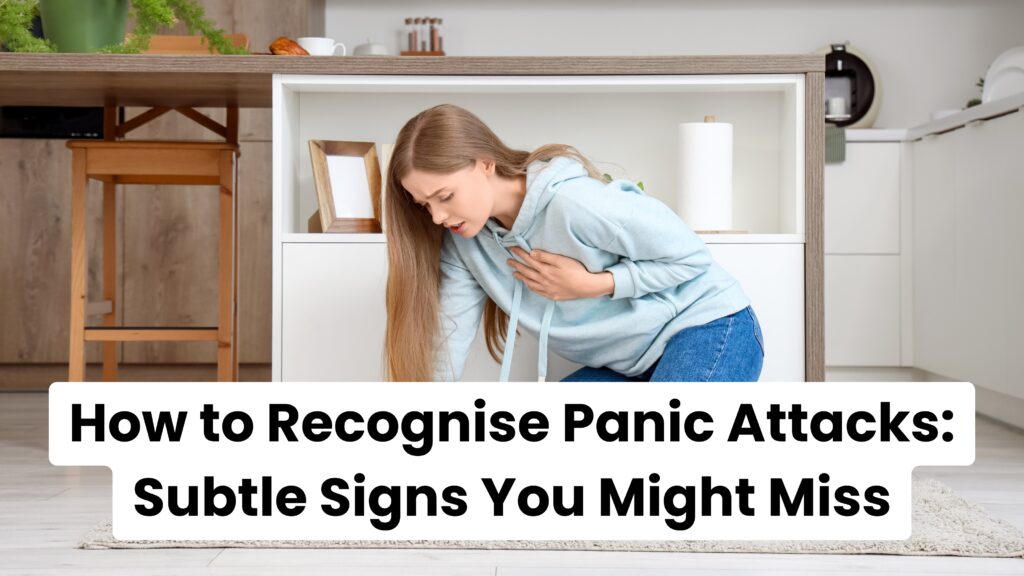
We all know the “Hollywood” version of a panic attack. It’s a character clutching their chest, gasping for air, absolutely certain they are having a heart attack. The world spins, they slide down a wall, and everything is dramatic, obvious, and terrifying. This is a real, and devastating, experience for millions. This is the classic panic attack, and it often leads to a frantic trip to the ER, only to be told, “It’s not your heart; it was a panic attack.”
But what if a panic attack doesn’t always roar? What if, sometimes, it just… hums?
What if your panic attack symptoms aren’t a sudden, violent explosion, but a strange, unsettling shift in reality? What if it’s a sudden wave of dizziness with no chest pain? What if it’s a terrifying feeling of being “unreal,” as if you’re watching your own life from outside your body? What if it’s just a sudden, unexplainable sense of impending doom that descends on a perfectly normal Tuesday?
These are the subtle signs of a panic attack, and they are the ones we miss.
Welcome to your complete guide to understanding panic attacks in all their forms. We are going to dive deep, not just into the well-known panic attack symptoms, but into the quiet, confusing, and “subtle” signs that leave you feeling like you’re “going crazy.” You are not. You are experiencing a real, physiological event.
This is a human-to-human conversation about the body’s “false alarm,” the triggers for panic attacks, and the powerful coping mechanisms for panic attacks that can give you back control. We will explore what is a panic attack, the critical difference between a panic attack vs anxiety attack, and the life-changing panic disorder treatment options available.
This is a long and in-depth guide, because you deserve comprehensive answers. And at the end, we’ll talk about the path forward—how professionals like Dr. Ankesh Singh at COGNiZEN CARE can help you turn down the volume on this alarm for good.
Chapter 1: What is a Panic Attack? (It’s Not Just “A Lot of Anxiety”)
Before we can spot the subtle signs, we have to understand the beast.
What is a panic attack? A panic attack is a sudden, intense surge of overwhelming fear or discomfort that peaks within minutes. It is a biological event. It’s the body’s “fight or flight” system—your sympathetic nervous system—going into overdrive.
Think of it this way: your brain has a “tiger alarm.” It’s an ancient system designed to save your life. When a real tiger (or a speeding car) appears, this alarm floods your body with adrenaline. Your heart pounds to pump blood to your muscles. You breathe faster to get more oxygen. You sweat to cool down. Your pupils dilate to see better. This is an amazing survival mechanism.
A panic attack is that exact same alarm system… but there is no tiger. It’s a “false alarm” of catastrophic proportions. It’s a sudden panic attack that feels completely unprovoked, which is what makes it so terrifying.
The #1 Question: Panic Attack vs. Anxiety Attack?
This is the most important distinction in the world of anxiety disorders, and the terms are often misused.
- Anxiety Attack: This term isn’t in the DSM (the diagnostic manual). It’s a lay term, and it usually describes a build-up of anxiety. You have a stressful week, a big project, a fight with your partner… your anxiety simmers and grows until it boils over. It’s a slow burn, usually tied to a specific stressor.
- Panic Attack: This is a surge. It’s a “volcano” eruption. It’s defined by its sudden onset, its extreme intensity, and the fact that it often comes out of the blue, as an unexpected panic attack.
You can have anxiety about having a panic attack, but the attack itself is a distinct, acute event.
This leads to Panic Disorder. Panic Disorder isn’t just “having panic attacks.” Panic Disorder is a condition where you live in fear of the next panic attack. The fear of fear becomes the real prison, often leading to agoraphobia—the fear of being in places where an attack might happen and you can’t escape.
Chapter 2: The “Big Five” – The Classic Signs You Can’t Ignore
We must cover these first, because they are the most common and the most frightening. These are the panic attack symptoms that send people to the hospital.
- Pounding Heart & Heart Palpitations (Tachycardia): This is the “Am I having a heart attack?” symptom. Your heart isn’t just beating fast; it feels like it’s pounding, skipping beats, or going to burst out of your chest. This is a direct result of the adrenaline surge.
- Shortness of Breath (Dyspnea) & Smothering Sensation: This is the “I can’t breathe!” feeling. You feel like you’re suffocating, or like your throat is closing. This often leads to hyperventilation (breathing too fast and shallowly), which then causes a cascade of other symptoms, like dizziness.
- Chest Pain or Discomfort: The other “heart attack” symptom. The chest pain can be sharp or dull. It’s caused by the muscles in your chest wall tensing up from the extreme stress and hyperventilation.
- Dizziness, Lightheadedness, or Feeling Faint: The world tilts. You feel unsteady, like you’re about to pass out. This is caused by the changes in your breathing (that hyperventilation again) and the sudden rush of hormones.
- A Sense of Impending Doom / Fear of Dying: This is the core psychological component. It is not just “being scared.” It is an absolute, unshakable certainty that you are about to die, lose control, or “go crazy.” This sense of impending doom is one of the most terrifying panic symptoms of all.
If you experience these, especially with chest pain and shortness of breath, you should always get checked by a doctor to rule out a medical issue. But if you’re told it wasn’t your heart, it’s time to explore the world of anxiety disorders.
Chapter 3: The Secret Attack – The Subtle Signs You Are Definitely Missing
Now we get to the heart of the matter. This is the “subtle signs” chapter. Not every panic attack comes with all ten symptoms blazing. Sometimes, it’s a limited-symptom panic attack where one of these weird, subtle symptoms is the main event.
These are the panic attack symptoms that make you feel like you’re losing your mind, not just your breath.
Subtle Sign 1: Derealization & Depersonalization (The “Unreal” Feeling)
This is, by far, the most confusing and subtle sign. It’s so disorienting that many people can’t even find the words to describe it.
- Derealization: This is when the world around you feels “off.” It’s a feeling of unreality.
- What it feels like: You’re looking at the world through a fog or a thick pane of glass. Sounds seem distant or muffled. Colors seem “too bright” or “flat.” It feels like you’re in a movie or a dream, and nothing is real.
- Depersonalization: This is when you feel “off.” You feel detached from your own body, thoughts, or feelings.
- What it feels like: You’re a “robot” just going through the motions. You’re watching yourself from outside your body, as if you’re a character in a video game. Your own hand might look strange and unfamiliar.
This feeling of detachment is a powerful, terrifying panic symptom. It’s your brain’s defense mechanism, a “psychological fuse” that blows to protect you from the overwhelming sensory input of the panic attack. You are not “going crazy.” This is a known, documented, and treatable sign of a panic attack.
Subtle Sign 2: Numbness and Tingling (Paresthesia)
You’re sitting at your desk, and suddenly, your hands and your lips start to tingle and feel numb. Your first thought? “Am I having a stroke?”
This numbness and tingling is a classic, but subtle, panic attack symptom.
- Why it happens: It’s a direct result of hyperventilation. When you over-breathe, you blow off too much carbon dioxide. This changes the pH of your blood, which in turn causes this tingling (paresthesia), often in your extremities (hands, feet) and around your mouth.
- It’s not dangerous, but it feeds the panic. You feel the tingling, you think it’s a stroke, which makes you panic more, which makes you hyperventilate more, which makes you tingle more. It’s a vicious anxiety cycle.
Subtle Sign 3: Sudden Chills or Intense Hot Flashes
One minute you’re fine, the next you’re drenched in a cold sweat or feel a burning hot flash rise up your chest and neck. You’re not sick. You’re not going through menopause. You’re having a panic attack.
This is your “fight or flight” system going haywire with your body’s thermostat. The adrenaline rush is pulling blood away from your skin (causing chills) and towards your big muscles, while your entire system is in overdrive (causing hot flashes). It’s a physiological storm.
Subtle Sign 4: The Sudden “Stomach Drop” (Gastrointestinal Distress)
Anxiety is not just in your head. It’s in your gut. The gut-brain axis is a super-highway of information.
- When your brain sounds the “tiger alarm,” one of the first things it does is shut down “non-essential” systems, like digestion.
- This causes a sudden, intense wave of nausea. It’s that “stomach drop” feeling, like you’re on a roller coaster.
- It can also cause sudden stomach problems—sharp cramps, bloating, or an immediate, undeniable urge to use the bathroom.
Many people with chronic panic symptoms are misdiagnosed for years with Irritable Bowel Syndrome (IBS), when in fact their stomach problems are a primary sign of a panic attack.
Subtle Sign 5: Intense Brain Fog & Sensory Overload
This is different from dizziness. This is a cognitive “shutdown.”
- Brain Fog: You’re in the middle of a sentence, and your mind just… goes blank. You can’t find your words. You can’t track the conversation. It feels like your brain is filled with cotton wool.
- Sensory Overload: Suddenly, the lights in the office are too bright. The sound of the printer is too loud. The smell of someone’s perfume is overwhelming.
This is your anxiety taking all your “RAM” or processing power. Your brain is so busy dealing with the “tiger” that it has no resources left for simple things like concentration or filtering sensory input.
Subtle Sign 6: Nocturnal Panic Attacks (The “Night Terror”)
This is one of the most terrifying and subtle signs of all, because you don’t even see it coming. You go to sleep perfectly fine, but you wake up from a dead sleep in a full-blown panic attack—heart pounding, gasping for air, drenched in sweat.
This is not a nightmare. A nightmare is a bad dream you wake up from. A nocturnal panic attack is a physiological event that happens to you while you are asleep (often in the non-REM stages) and then wakes you up.
People who have nocturnal panic attacks often blame their mattress, what they ate, or a bad dream. They rarely connect it to an anxiety disorder. But it’s a major red flag that your nervous system is on high alert, even when you’re unconscious.
Chapter 4: “Why Me?” – Unpacking Your Panic Attack Triggers
Understanding the “why” is a huge part of panic attack recovery. Your panic attack triggers can be obvious, or they can be deeply hidden. What are the causes of panic attacks?
- Obvious Triggers:
- Chronic Stress: This is the big one. Your “stress bucket” is just too full. A high-stress job, family problems, or financial worries keep your nervous system on a high simmer, making a boil-over inevitable.
- Caffeine: A cup of coffee is a stimulant. For a person prone to anxiety, it’s like throwing gasoline on a smoldering fire.
- Lack of Sleep: Sleep deprivation is a massive trigger. It robs your brain of its ability to regulate emotion.
- Hangovers: Alcohol withdrawal is a classic trigger for anxiety and panic attacks.
- Hidden Triggers:
- Trauma & PTSD: Your body “remembers” trauma. A certain smell, a specific sound, or an anniversary date can trigger a panic attack that feels like a flashback.
- Physical Sensations: This is a key part of Panic Disorder. The trigger becomes… the symptom. Your heart beats fast from walking up the stairs, your brain misinterprets that as “danger,” and that misinterpretation triggers a full panic attack.
- Other Mental Health Conditions: Panic attacks can be a symptom of another anxiety disorder, like Generalized Anxiety Disorder (GAD), Social Anxiety, or OCD.
- Agoraphobia: This is both a cause and a result. You have a panic attack in a grocery store. The next week, you get anxious entering the store. That anticipatory anxiety then triggers another panic attack. Soon, you’re afraid of the store itself.
Chapter 5: “It’s Happening!” – How to Stop a Panic Attack (Your First-Aid Kit)
Okay, you’ve recognized the subtle signs. You feel the derealization creeping in, the numbness and tingling in your fingers. It’s happening. What do you do right now?
Here are the most effective coping mechanisms for panic attacks.
1. The Golden Rule: DON’T Fight It. Ride the Wave.
This is the hardest, but most important, rule of panic attack management. Your first instinct is to fight, to run, to scream “STOP!” This adds “fear of the fear” and makes it worse. A panic attack is a wave of adrenaline. It will peak, and it will pass. It cannot last forever (biologically, your body will run out of the chemicals).
- Your Mantra: “This is a panic attack. I’ve had them before. It is not dangerous. It is just uncomfortable. I will ride this wave.”
2. Breathe. (But Breathe Correctly to Stop Hyperventilation!)
Many people say “take a deep breath,” which can actually make you hyperventilate more. You need to slow your breathing down.
- Deep Diaphragmatic Breathing: Breathe from your belly, not your chest.
- The 4-7-8 Breathing Technique:
- Exhale completely.
- Inhale through your nose for 4 seconds.
- Hold your breath for 7 seconds.
- Exhale slowly through your mouth (like blowing through a straw) for 8 seconds.
- Repeat this 3-4 times. This breathing exercise for anxiety is a powerful coping strategy that forces your nervous system to calm down.
3. Anchor Yourself with Grounding Techniques (The 5-4-3-2-1 Method)
This is the single most powerful grounding technique to pull your mind out of the “what if” future and back into the “right now” present. It reconnects you with reality.
- The 5-4-3-2-1 Grounding Method:
- 5: SEE. Look around you and name (out loud or in your head) five things you can see. “I see the blue pen. I see the crack in the ceiling. I see my fingernail. I see the dust on the table. I see the lamp.”
- 4: FEEL. Name four things you can feel. “I feel the floor under my feet. I feel the soft fabric of my sweater. I feel the cold ice in my hand. I feel the tension in my shoulders.”
- 3: HEAR. Name three things you can hear. “I hear the hum of the computer. I hear the clock ticking. I hear the traffic outside.”
- 2: SMELL. Name two things you can smell. “I smell the coffee on my desk. I smell the hand sanitizer.”
- 1: TASTE. Name one thing you can taste. “I can taste the mint from my gum” or “I can taste the metallic tang of anxiety.”
This coping with panic attacks technique works. It breaks the anxiety cycle by forcing your brain to focus on sensory input, not catastrophic thoughts.
4. Engage Your Senses (The “Shock” Method)
- Hold an ice cube in your hand. The intense cold is a powerful grounding sensation.
- Sip very cold water.
- Sniff a strong scent, like a peppermint oil or a lemon peel.
- Splash cold water on your face. These sensations are “pattern interrupters” that can jolt your brain out of the panic loop.
Chapter 6: Beyond the Attack – The Long-Term Treatment for Panic Disorder
Coping mechanisms are for the battle. Panic Disorder Treatment is for winning the war. You have tried the grounding techniques. You have the coping skills. But you’re exhausted. You’re tired of fighting. You’ve stopped going places just in case. The fear of fear has won.
It’s time for professional help for panic attacks. This is the bravest, strongest step you can take. Anxiety relief is not just about coping; it’s about healing.
When to Get Help for Panic Attacks?
The second you feel your world is “shrinking.” The second you avoid a social event, a car, or a grocery store because you’re afraid you might have an attack. That is when you need to call a psychiatrist for anxiety.
Here is what panic disorder treatment—the gold standard—looks like.
1. Therapy for Panic Attacks: The Gold Standard
The #1 treatment, with the best long-term results, is CBT for Panic Disorder (Cognitive Behavioral Therapy). This is not just “talk therapy.” This is a practical, skills-based anxiety treatment.
- Cognitive Part: This is where you learn to identify and challenge your catastrophic thoughts.
- Thought: “My heart is racing, I’m having a heart attack!”
- Challenge: “My heart is racing, but this has happened before. It’s an adrenaline rush. It is a panic symptom, not a heart attack. I am safe.”
- Behavioral Part (This is the magic): This is called Interoceptive Exposure.
- This sounds scary, but it’s life-changing. Your therapist will safely, in the office, help you induce the subtle signs you’ve learned to fear.
- They might have you spin in a chair to get dizzy. Or breathe through a straw to feel a little short of breath.
- The Goal: You break the connection. You teach your brain, “See? I can be dizzy, and I don’t have to have a panic attack. Dizziness is not dangerous.” This is how you reclaim your life from Panic Disorder.
2. Medication for Panic Attacks
For many people, medication for panic attacks is a life-saving tool that calms the nervous system down enough to let the CBT work.
- SSRIs (Antidepressants): These are the most common long-term, preventative medications. They work by regulating serotonin, which helps lower your baseline anxiety and reduce the frequency and intensity of attacks.
- Benzodiazepines (Short-Term): These are fast-acting “rescue” medications. They are very effective at stopping a panic attack in its tracks. However, they are highly addictive and are not a long-term solution. They are a crutch, not a cure.
A holistic treatment plan often uses CBT for Panic Disorder as the primary strategy, with medication as a supportive tool.
Conclusion: You Are Not “Going Crazy,” and You Are Not Alone
Reading this, you might be feeling a powerful sense of recognition. You might be connecting the dots—that the dizziness, the numbness and tingling, the brain fog, and the “unreal” feeling of derealization aren’t random, scary events. They are all subtle signs of a panic attack.
Living with panic attacks is exhausting. It’s a lonely, isolating experience. But it doesn’t have to be your story. Your panic attack symptoms are real, they are treatable, and you do not have to live in fear.
This is especially true in a high-stress, high-achieving environment like Delhi NCR or Gurgaon. The pressure to be “on” all the time can be a breeding ground for anxiety disorders.
If you or someone you love is trapped in the cycle of panic disorder—if your world is shrinking from the fear of fear—it’s time to seek professional help.
This is where a compassionate, expert psychiatrist for anxiety becomes your most important ally. A specialist like Dr. Ankesh Singh at COGNiZEN CARE, a premier mental health clinic in Gurgaon, understands the whole picture.
He and his team won’t just look at your panic attack. They will look at you. They understand the deep connection between your stress, your anxiety, your trauma, and these terrifying physiological events. They know how to differentiate a panic attack vs anxiety attack and how to spot the subtle signs that others miss.
At COGNiZEN CARE, the anxiety treatment in Delhi NCR is not one-size-fits-all. Dr. Ankesh Singh will develop a holistic treatment plan that gets to the root of your panic attacks. This plan will combine the “gold standard” of CBT for Panic Disorder with other coping strategies, lifestyle changes, and medication (if needed) to create a comprehensive path to anxiety relief.
You are not broken. Your brain’s alarm system is just a little too sensitive right now. You can learn to recalibrate it. You can learn to feel safe in your own body again.
The first, bravest step on your journey to mental wellness is reaching out.
To start your journey toward a calmer, more peaceful life, contact Dr. Ankesh Singh and the team at COGNiZEN CARE today.